According to the occult, chess reenacts a primordial cosmic struggle amongst the factions of the gods. Chess was brought to man through the spirit of revelation as a game, and has been preserved across the ages in the form of western chess, xiangqi, shogi, mongolian chess, thai chess, and other variants. I believe this is the most faithful preservation of the original game, per a synthesis of historical sources and more importantly from the work of Tracy Twyman.
The motivation for my creation of this game was to follow how Tracy Twyman claimed chess should be played. For context, Tracy Twyman was an author who wrote books on esoteric history, and one topic covered in depth in her books is the occult history of chess – which I will try to discuss in this essay.
Origins of Chess
As you, my dear reader, probably know, chess came from somewhere around India and was spread to Europe through Arab traders. Here is a world map of the chess variants:
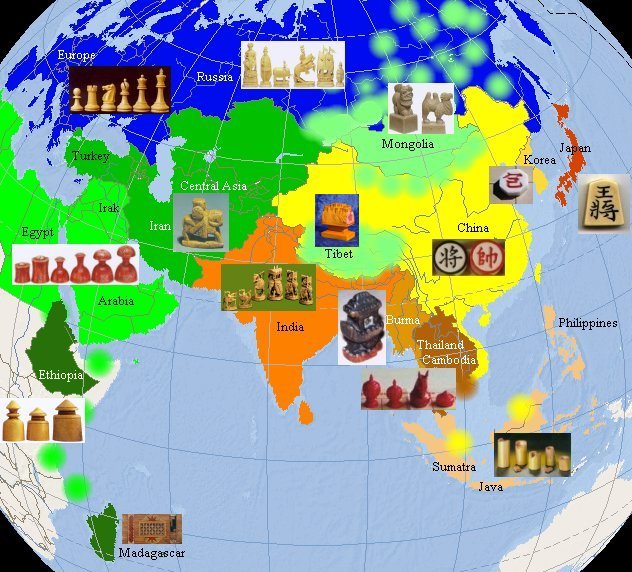
As you can see, the game of chess has been hugely successful, and across history has been spread to basically every part of Eurasia in mutated forms.
But what many people don’t know is that chess also has a deep esoteric history, connecting it to the movements of the heavens and to the struggles amongst the gods.
Representation according to Iranians
One of the earliest accounts of the game of chess occurs when the Sasanian (Persian) king Khosrow I Anushirvan exchanges letters with the Indian king Dēwišarm about chess in about 531-579 AD. In these letters, the Iranians are challenged to decode the meaning of chess, otherwise they must pay tribute to the Indians, and the Iranians successfully do so. Here is the meaning per the Iranian vizier Wuzurgmihr:
- The board represents earth.
- The 30 pieces represent the 30 day-nights in the month – 15 for the day, and 15 for the night.
- The die (early chess had die) stands for the revolution of the stars and the turning of the firmament.
- The movement of the pieces resulting from the dice movements represents how people in the material world, bound to the spiritual world, move under the seven planets and the twelve zodiac signs.
Muruj al-dhahab
According to Muruj al-dhahab, a famed Arab Historian who lived around 896–956 CE, chess is an allegory of the heavenly bodies, the seven planets and the twelve zodiac signs, and each piece is dedicated to a star. Moreover, chess isn’t merely intended to model warfare, but is also intended to symbolize how the heavens are bound to the soul. And to note, this historian isn’t saying this is his idea, but merely claims to be reporting earlier (now lost) Indian books.
Astrological Games
In the 1283 book, Libro de los juegos (written for King Alfonso X of Castile), a variant of chess is provided in which the board is composed of concentric circles, with the outer ring divided according to the 12 zodiacs, and the inner ring assigned to the planets.
Enochian Chess
Similar to what I have done here, the Order of the Golden Dawn has its own variant of chess modeled after the original rules of Chaturanga. In their model, each piece is connected to a different Egyptian God, and each chess game is in fact a form of divination, in which each game gives a glimpse on the actual movements of the gods. Their boards also have four teams, in accordance with Chaturanga, which also had four teams, thus corresponding to their cosmology in which there four main camps of divine entities, assigned to four different watchtowers and cardinal directions, which rival each other for control over the earth.
It is also said that the esoteric traditions of chess are preserved among the Free Masons in the classic black and white checkerboard floor of their lodges. In fact, freemasons claim that chess is an allegory for life, and the dark and white squares represent a balance between good and evil, joy and sorrow.
Chess and the 52 Card Deck
In the 19th century, many historians believed that the 52 card deck came from the original version of chess, Chaturanga, for the following reasons:
- Both games came from the same central Asia region.
- It is believed that Chaturanga actually had 4 teams playing against each other, where each team earned points from taking out the pieces of the other team. These four teams correspond to the 4 suites in the card deck, and the points gained from capturing specific pieces from the other teams correspond with the many card games where each card is associated with a number of points.
- The original game of Chaturanga was played with die, which controlled which piece could play – similar to how modern card games start with chance.
- Each pawn corresponds to cards numbered 1-10, and each face card (king, queen, jack, ace) corresponds roughly to main chess pieces behind the pawns.
Therefore, since early chaturanga had its points somewhat determined by the dice rolls during the game, one can easily imagine that the card deck is an innovation on this, in which they took away the board and simply allotted by chance the players tokens representing the pieces they might have earned on the board. This makes more sense if one imagines that early chess used animal skins rather than carved figurines, as is claimed by Tracy Twyman – and so when you earned points by capturing an enemy piece, these points really did look similar to cards.
Tracy Twyman
The insights that Tracy Twyman adds to chess are specifically that the pawns should move horizontally in their capture, that the game is only won when the king is captured, that the bishops must be captured first before the king, and that there is an inner 6x6 square of the board which is particularly important in winning the game. I have tried my best to faithfully replicate these rules here – I copied the pawn horizontal capture, and my solution for the bishop must die first is that the king can be reborn from one of his bishops (killing the bishop) if the bishop is still alive. This bishop thing, by the way, actually solves a problem in normal chess in that even if one side is losing, it is possible that it can check the enemy king infinitely with its queen, causing a draw. On the other hand, in my variant, if the king can be reborn from a bishop, then it is much more difficult for the losing side to cause a draw in this fashion because you can’t really check an enemy king if he has bishops still alive.
These insights were delivered to Twyman, quite frankly, by demonic entities through an Ouija Board. These entities also describe chess as a game intended to model a primordial conflict before Noah’s flood.
This is just something that you have to accept about Twyman’s work: it is 95% the product of conventional history research, but the other 5% is from revelations directing her on which topics to research or providing key details which otherwise couldn’t be known.
The reason why I personally believe Twyman is because many of the things these spirits taught her are things that I was taught in my dreams / visions as well, before I ever knew these teachings of Twyman. And to note: I am trying my best to use my discernment here – I know that some of the things revealed to her will be false, since she was talking to self described demonic entities, but I still think there might be a core of truth transmitted by these entities – of which truth is easier for me to differentiate, because I can cross check it with my own revelations, which I am pretty certain are not from demonic entities. These shared truths include:
- The “demonic” side in the cosmic struggle is not unified.
- The sun going dark and being replaced with the moon.
- Ancient civilizations sinking into the earth into a literal underworld.
- The moon being not what we think it is, and planets being associated with beings that are alive.
- Proto English having a special occultic power.
- Chess – I also have had dreams about the occult power of chess before reading her books!
Also, having read some of her books, it is obvious to me that she was a genius. And if you are not totally cynical then it is worth noting that she claims to have revelations which she then later found to correspond with the actual historical record – for example, the demonic entity told her that proto-chess came from Afghanistan, which does actually correspond to the region where the earliest chess boards are found.
It’s also worth noting that in her book, Clock Shavings, she appears to believe that the rules that she provides are the original rules of chess. For instance, she cites how the pawns in xianqi also move horizontally, implying that her revelations are in fact indicating how chess originally was played. I’m not sure if I agree with this though… in my opinion, the rules revealed to her represent how chess is supposed to be played, and chess has slowly been evolving to become increasingly similar to this blueprint because it resonates with our souls in some fashion.
By revelation
To summarize my dreams on chess:
- I have dreamt a few times that chess is evil and demonic.
- I dreamt that pawns should look like castle walls, and I saw these walls almost impenetrably encompassing part of the board. I then later found this is the natural result of having horizontal capture in pawns – the pawns are able to create regions which are nearly impenetrable.
- I dreamt that the pawns should morph in appearance to be more like Christian statues once they get two squares forward.
- I was told in a dream that I should share this game with the world.
I also dreamt that the hunchback piece should be placed in the 8x8 square, rather than immediately next to the king and queen. For context, I decided to make this game 10x10, because it made sense to me that if pieces move into the 6x6 inner square (discussed by Tracy Twyman) to take control of it, then they must not actually start in this square (in normal chess, pawns do start in this square). As such, I needed to add a new piece, which I decided to be the minister piece, which moves only one square vertically or horizontally.
I chose this because many of the early chess variants with 10x10 boards (such as Shatranj al-tamma or Termlane) also had this piece or a piece very similar. In accordance with these traditions, I therefore originally placed these two minister pieces directly around the king and queen. However, this caused problems, because now each pawn is not defended by a back-rank piece. When I instead moved this piece in accordance with my dream to the 8x8 square position (directly next to the rook), this problem was solved – now each pawn is defended by a back rank position. Moreover, each back rank piece is defended by another piece (previously, this was not the case, because no pieces defended the rook), so I think this tidbit from my dream improved the game. Also, I made this piece appear as a hunchback, because the dream told me to do so – previously it was a battering ram. Again, this fits into my model, because the vice label for that piece already was “sloth”, and it makes sense that a hunchback person would represent sloth.
The rest of the elements of the game I chose basically because I felt I was inspired to make them that way. And honestly, I very much doubt this game I have made would be even remotely as good as it is, had I not been working under inspiration, and instead simply going by my own intuitions. I also was pleased to discover that many ancient traditions connect the game with the 7 planets and the zodiac, because when I originally felt inspired to place those symbols on the board, I was not aware of this history.
One thing I decided not to do in this game is make the team structure be red and black, as was revealed to Twyman. In my view, this color code makes the game seem too evil, and I think it reflects the demonic motivation to have both teams represent evil forces – cutting out the good, as if good never existed. As such, I didn’t do this. Interestingly, red and black are the colors played in checkers, and in clock-shavings, Twyman also is instructed to lay out tokens across the board to be placed underneath the chess pieces in a very checkers type fashion. Which is all to say that there may be some relationship between chess and checkers that these entities were trying to hint at, but I am not sure on this.
Ultimately, my view is that there is a sort of divine blue-print for how chess should be played – and both the good side and the evil side in heaven know about it. Since Twyman was communing with dark forces, the variant revealed to her was a bit twisted, and so I have tried my best here to fix it so that the game is portrayed in the correct fashion: a struggle between good and evil – and not a struggle between various sects of demons, as is played in Enochian chess.
It’s also worth noting that on my first day when the game was basically complete, I had a dream about several different things relating to the end of the world, which are mostly outside the scope of this website. One of those things however was a prophecy that a figure told me was a prophecy of how the rook would take the bishop. This is noteworthy, because I was inspired, right before I went to sleep, to assign virtues and vices to each piece on this night, and therefore I can now interpret this prophecy: the rook taking the bishop represents greed supplanting justice.
Why this variant of chess is better
Strategically, because the queen is relatively less important, and the pawns stronger (since they can defend each other), and the center much larger, controlling the center in this chess variant is much more complex. As such, this variant in my view is much more about territorial domination, rather than little tricks played against the opponent, which makes this game more strategic (which emphasizes long term strategy) and less tactical (which emphasizes small maneuvers), which I think is better.
More broadly, the special thing about chess compared to other board games is that it is much more appealing to novices than other alternatives. Even if you aren’t great at chess, you can kind of understand and relate to the territorial advances and sacrifices made by great chess players. As such, watching people play chess is much more entertaining than watching people play checkers or baduk – since for those games, the game is so abstract that most people don’t really have any idea what is going on.
I think this variant increases that because – firstly – since the game is more about gaining territory, it gives a more tangible objective that unlearned people can watch and be entertained by – as opposed to the much more abstract decisions about balancing pressure and maneuvering pieces which are eminent in standard chess.
Secondly, I believe this variant is more entertaining because it better portrays a cosmic struggle in the symbolism of the pieces. This, I believe, is one of the reasons why normal chess is so much more of a mass spectacle than any other game (such as, for example, Backgammon): People feel that there is a spiritual meaning behind the game which they feel drawn too, since even normal chess already has plentiful symbolism of light versus darkness and cosmic struggle. And to emphasize: when chess masters play, entire auditoriums fill up with spectators, but when masters play checkers, nobody cares, and any YouTube video of it will only get a few thousand views at best. Similarly, the games usually chosen in movies to be played in a symbolic fashion are either chess or the 52 card deck games – not other games – because both of these games have an almost spiritual energy (since they come from the source), which contributes to the symbolism of the film.
Well, I believe the symbolism in this chess variant – called Ageio, the name having been revealed to Twyman – increases the cosmic struggle allegory of chess, thus making the game of chess much more entertaining both to play and to watch.
Hopefully, you, my dear reader, can be entertained by this game. And thanks for reading! May God bless you!